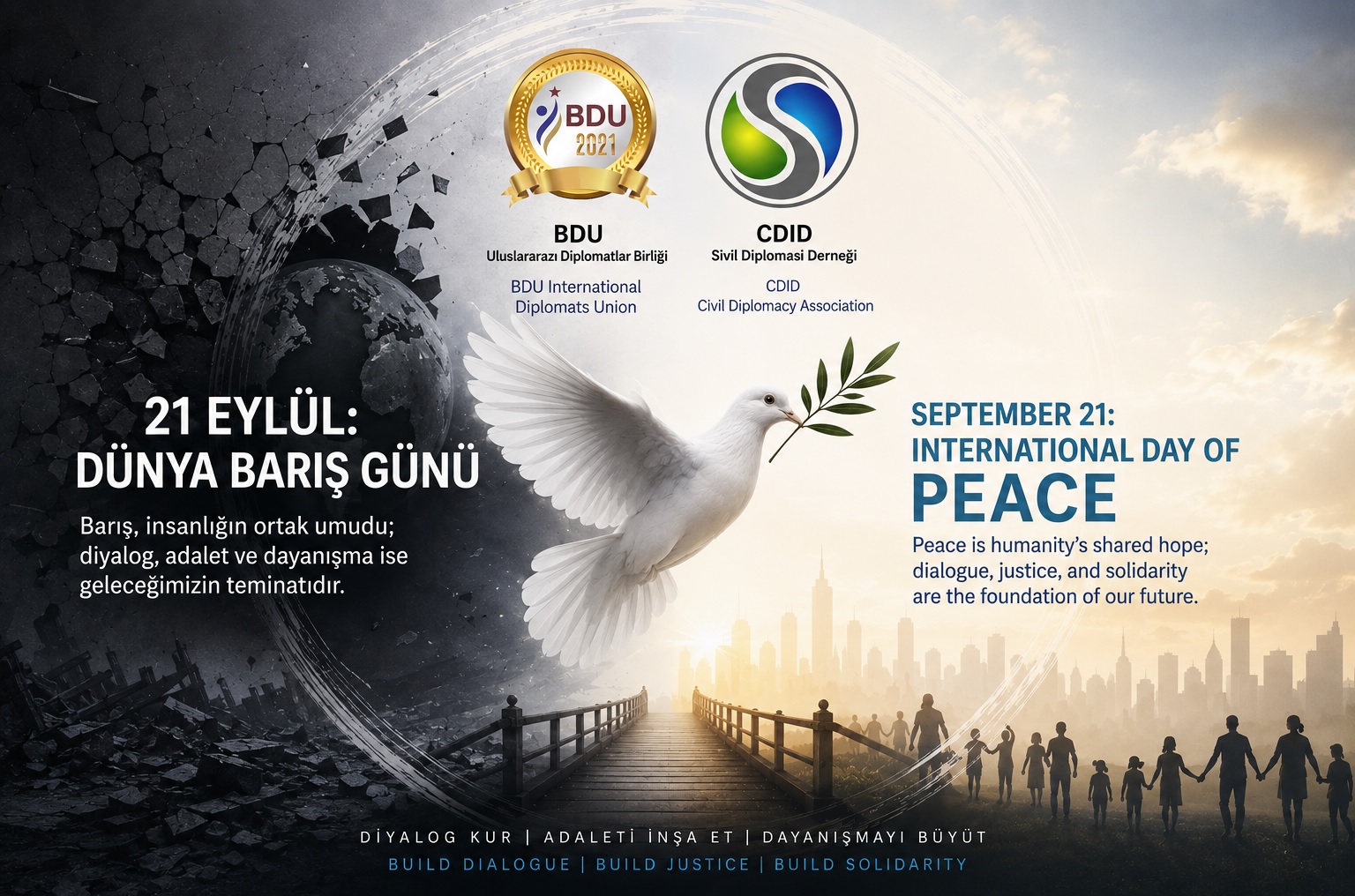
As the BDU International Diplomats’ Union and the CDBA Civil Diplomacy and Business World Association for, we do not view peace merely as the end of wars or the silence of weapons. For us, peace means upholding human dignity, justice, security, freedom, mutual respect, solidarity, and hope. Because true and lasting peace is possible not only through agreements signed between states, but also through societies’ understanding of one another, respect for their differences, and the will to build a shared future.
Today, the world faces wars, conflicts, forced migration, poverty, economic inequalities, discrimination, social polarization, humanitarian crises, and growing insecurity. This reality shows us that peace is not solely the responsibility of states and governments. Peace is a shared responsibility not only of states but also of diplomatic circles, civil society organizations, the business community, academics, young people, artists, opinion leaders, and all people. This is because the sustainability of peace depends on societies embracing a culture of peace and making it an integral part of daily life.
For this reason, as the BDU International Diplomats’ Union and the CDBA Civil Diplomacy and Business World Association, we believe that, alongside intergovernmental diplomacy, civil diplomacy, humanitarian diplomacy, and dialogue among societies must be strengthened. Diplomacy is no longer merely a form of interaction conducted between the official institutions of states. In today’s world, communities, universities, think tanks, civil society organizations, the business community, professional associations, youth movements, and cultural circles are also key actors in international relations. Civil diplomacy is a powerful tool for peace that builds trust among societies, keeps channels of communication open, reduces prejudices, and fosters cooperation based on shared interests.
Our understanding of human peace places the human being at the center, beyond all differences. Human peace is the ability of a person to look beyond borders, nationalities, religions, languages, races, cultures, and political differences to see the person in front of them first and foremost as a human being. It aims not to eliminate differences, but to foster a culture of living together in harmony and security despite those differences. Because differences are not humanity’s problem—they are humanity’s shared wealth. Dialogue exists not to erase differences, but to prevent them from turning into conflict.
Humanistic peace begins with the protection of human dignity. A child who sleeps without fear is peace. Welcoming a refugee in a manner befitting their dignity is peace. Meeting the needs of a hungry person without humiliating them is peace. A young person being able to look to the future with hope is peace. A society not being divided because of its differences is peace. A businessperson fostering mutual trust and prosperity among societies by establishing economic cooperation across borders is peace. Peace is when an academic can freely exchange ideas with those who hold different views. Peace is when two societies can come together around shared goals for the future without denying the pain of the past. And when a person can stand by another—without asking who they are, where they come from, or what they believe—touching their life and offering help—that is a true act of peace that makes the world a little more human.
We know that forgiveness does not mean erasing history. Forgiveness means not allowing the past to hold the future hostage. Humanity must not forget the suffering of the past, but neither should it allow that suffering to turn into new hostilities and new conflicts for future generations. History must be known, lessons must be learned from what has happened, and the pains of the past must be transformed into teachers to build a culture of peace for the future. Because we cannot change everything that happened in the past; however, we can decide what the future will inherit. It is within our power to leave future generations schools instead of battlefields, hospitals instead of ruins, books instead of weapons, dialogue instead of hatred, opportunity instead of despair, and bridges instead of walls.
The world does not need perfect people to build peace. The world needs sincere people who are willing to take the first step. A single act of kindness may seem small; yet the history of humanity has been transformed by small acts of kindness that have multiplied in the hearts of millions. For this reason, human peace is not merely the subject of grand diplomatic agreements or international summits. The hope a teacher instills in a student, a doctor’s determination to save a life, the opportunities an entrepreneur offers to young people, a volunteer’s helping hand extended to those in need, a diplomat’s effort to bring opposing sides to the same table, the bridges a civil society organization builds between communities, and the first step a person takes to understand another—all of these are peace itself.
Peace is a will before it becomes a treaty. Compassion is a choice before it becomes a culture. Dialogue is a mindset before it becomes a diplomatic mechanism. Humanity, meanwhile, is a matter of conscience before it becomes a civilizational project. For this reason, we must approach peace not merely as a concept that silences the sound of weapons, but as a comprehensive understanding aimed at eliminating the social, economic, political, and humanitarian causes that give rise to armed conflicts.
We, the BDU International Diplomats’ Union and the CDBA Civil Diplomacy and Business World Association, view it as our responsibility to strengthen dialogue among societies, promote civil diplomacy, protect human dignity, empower young people to become active agents of peace, develop the business community’s capacity to foster trust and shared prosperity among societies through economic relations, and enhance intercultural understanding. We believe that transnational challenges—such as climate change, migration, poverty, food security, digital transformation, economic inequality, and humanitarian crises—can only be resolved through collective wisdom, international cooperation, and a shared sense of responsibility.
Today, our world needs more trust, not more weapons; more dialogue, not more polarization; more bridges, not more walls; and more understanding, not more prejudice. We may live in different countries, speak different languages, and have different cultures, beliefs, and ideas. Yet we are all part of the same human family. We share the same world, live under the same sky, and shape the destiny of future generations together.
For this reason, as the BDU International Diplomats’ Union and the CDBA Civil Diplomacy and Business World Association, we call upon all states, international organizations, diplomats, civil society organizations, the business community, academic circles, young people, and all people of the world to take shared responsibility for a stronger dialogue, more inclusive solidarity, and a more humane world. Let us stand on the side of solutions, not conflicts; of understanding, not prejudice; of cooperation, not division; and of dialogue, not hatred. Let us not turn the pains of the past into the hostilities of the future. Let us place human dignity above all political, economic, and diplomatic calculations. Because true peace will be possible not when people seek to dominate one another, but when they learn to understand one another.
We choose peace. We choose dialogue. We choose human dignity. We choose civil diplomacy. We choose solidarity and a shared future. Because we believe that peace is the common will of humanity, even before it is enshrined in a treaty. Humanity will live in true peace only when it can see itself reflected in the face of every person.
We were not created to be strangers to one another on the same planet. We exist to build a shared future as a single human family under a single sky.
BDU International Diplomats’ Union & CDBA Civil Diplomacy and Business World Association