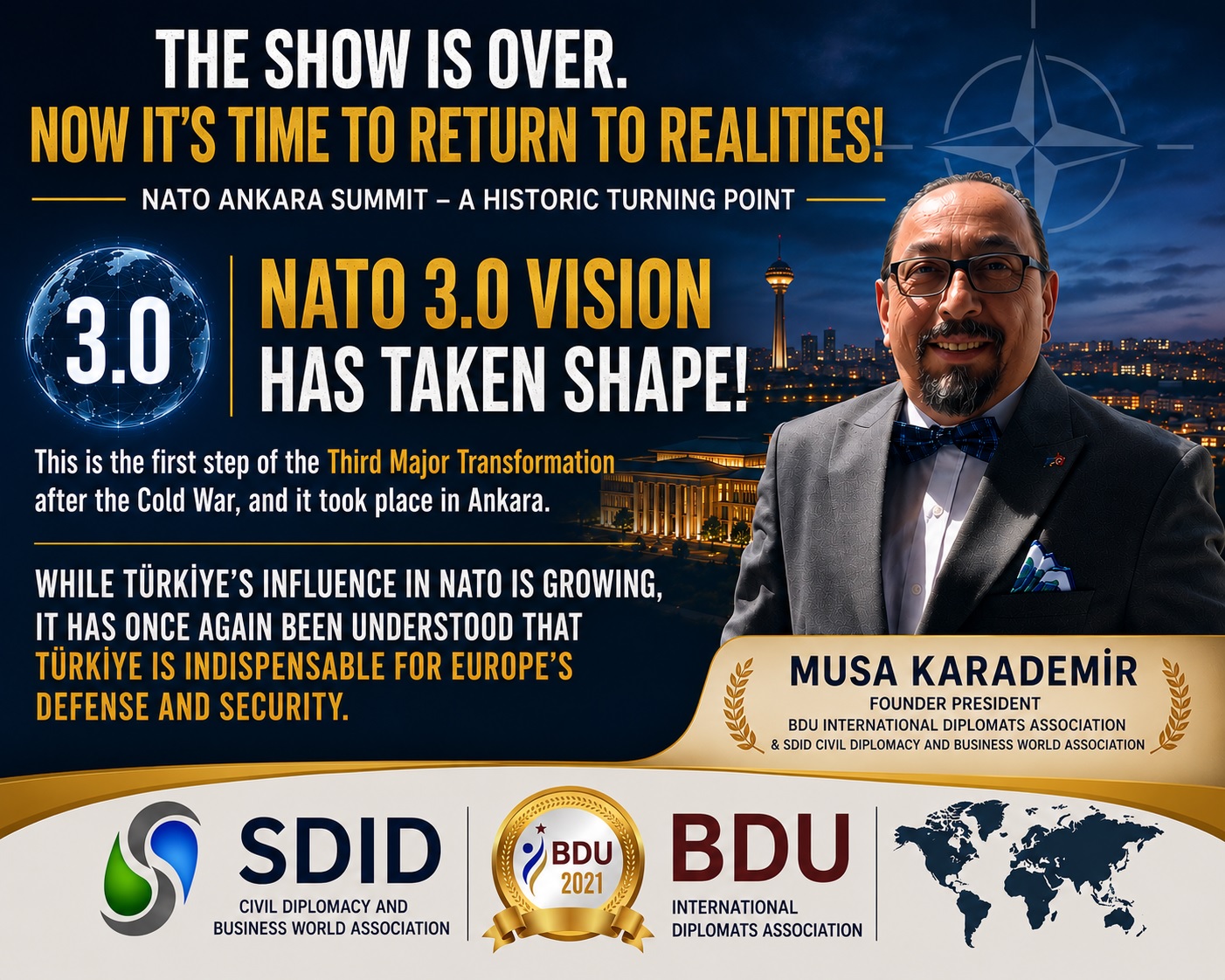
THE NATO ANKARA SUMMIT HAS COME TO AN END
‘THE NEW SECURITY ARCHITECTURE FOLLOWING THE NATO ANKARA SUMMIT: NATO 3.0 AND THE FUTURE OF TRANSATLANTIC RELATIONS’
The Show Is Over… Now It’s Time to Face the Facts
NATO’s Ankara Summit has concluded. Heads of state and government gathered around the same table for two days. Throughout the summit, the focus was not only on the leaders’ political and diplomatic engagements, but also on the cordial images and symbolic messages conveyed to the public. However, upon objective assessment, it is clear that behind the group photographs lie serious strategic differences of opinion.
Diplomacy may, at times, soften issues; yet it cannot completely conceal the facts. Despite the NATO Secretary-General’s messages of unity and solidarity, the differences of opinion within the alliance have now reached a level where the public can observe them. The cat is out of the bag.
The Final Communiqué issued at the conclusion of the Ankara Summit is structured under five key headings:
-
Collective Defence and NATO’s Unity
-
Russia, Terrorism and the Defence Industry
-
NATO’s Modernisation
-
Ukraine
-
Iran and the New Security Environment
These headings will continue to shape the international security agenda in the coming period. In particular, bringing the Russia-Ukraine war to an end and bringing Iran-centred regional tensions under control are among the most important expectations in terms of global stability.
NATO 3.0: A New Security Paradigm
The concept of ‘NATO 3.0’, which has been frequently discussed in recent times, is not a legal or institutional definition found in NATO’s official documents. Rather, it constitutes a conceptual framework expressing the political and strategic transformation of the Alliance’s future.
This approach is based on the following understanding:
“Whilst Europe assumes greater responsibility for its own security, the US will continue to provide its support as a strategic partner.”
Within this framework, NATO 3.0 represents a new security paradigm centred not only on strengthening military capabilities, but also on burden-sharing, the development of the defence industry, the integration of artificial intelligence and advanced technologies into the security architecture, cyber defence and societal resilience.
Alliances Within NATO Are Cracking
NATO, which was shaped by a shared perception of threat in the aftermath of the Cold War, is today perhaps experiencing one of its most complex periods since its inception. Whilst the Alliance’s military capabilities are growing, its political unity is failing to strengthen to the same extent.
Disagreements over defence spending, differing approaches to the war in Ukraine, Middle East policies, the rise of China and the increasing prioritisation of national interests are straining the bonds of trust between allies.
In particular, the differing stances that emerged during the Israel/US–Iran tensions have made European countries’ questioning of the US-centred approach to security more apparent. A clear gap has emerged amongst Alliance members between Washington’s priorities and Europe’s security concerns.
Furthermore, the harsh rhetoric employed by US President Donald Trump during the summit—which deviated from customary diplomatic norms—has been interpreted as one of the symbolic indicators of political tension within NATO. It appears we have entered an era in which the courtesy of diplomacy is, at times, being replaced by direct power politics.
Is the Alliance Cracking… Will NATO Disintegrate?
This is one of the most frequently asked questions today. In the short term, the dissolution of NATO is not a realistic scenario. This is because NATO is not merely a military alliance. It is a multi-layered security system comprising shared intelligence, an integrated command structure, defence industry partnerships, logistical networks and decades of institutional memory.
Russia’s return to power politics, growing security concerns in Europe and the intensification of global power competition make NATO’s continued existence essential. However, the real issue is not whether NATO will survive, but what form it will take.
The likelihood of the European Union enhancing its defence capabilities and establishing a more independent security architecture is growing. Even in such a scenario, NATO and Europe’s defence structures will continue to operate not as mutually exclusive but as two largely complementary pillars of security.
Conclusion and Assessment
The Ankara Summit has once again demonstrated that, from a military perspective, NATO remains the world’s strongest defence alliance. However, the summit has also revealed that the Alliance’s political solidarity is not as strong as it once was.
Today, the greatest threat facing NATO is not merely Russia, China, Iran or international terrorism. The real test lies in maintaining a shared strategic vision amongst allies, rebuilding trust and managing debates on burden-sharing.
The new security paradigm, referred to as ‘NATO 3.0’, indicates that the alliance has entered a process of transformation that is not merely military, but also technological, economic and geopolitical. Artificial intelligence, cyber security, space technologies, the protection of critical infrastructure and strategic autonomy in the defence industry will be key agenda items in the coming years.
Consequently, it is a more realistic approach to discuss NATO’s transformation rather than its dissolution. The coming decade will be a critical period that determines the Alliance’s future. If the allies can rebuild their shared perception of threats and strengthen their relationship of trust, NATO will continue to play a central role in the global security architecture. Otherwise, the image of an alliance that is militarily strong but with increasingly fragile political cohesion will be inevitable.
For history shows us this: it is not weapons alone that keep alliances standing. It is shared values, mutual trust and a shared vision for the future. When these weaken, even the strongest military structures begin to erode from within.