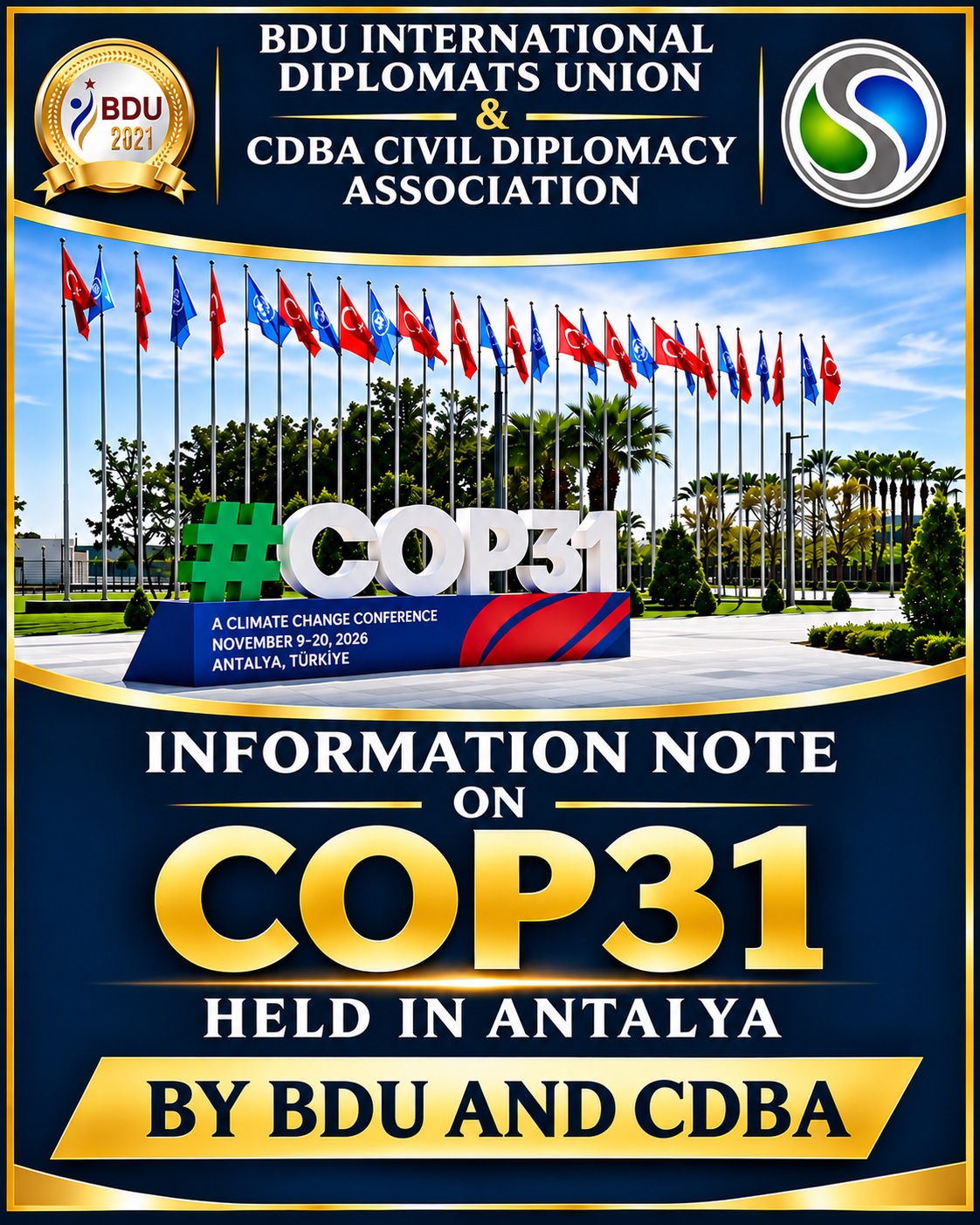
BDU Publishes Information Note for “COP 31 Antalya”

COP31 ANTALYA OUTCOMES: BDU AND SDID ASSESSMENT

Consensus in Climate Diplomacy, Just Transition and Responsibility for Implementation

Joint Press Statement by BDU International Businesspersons and Diplomats Union and CDBA Civil Diplomacy and Business World Association

The United Nations Climate Change Conference COP31, held in Antalya, has once again placed climate change at the centre of the international agenda at a time when the world is undergoing significant political, economic and environmental transformation.

Throughout the conference, representatives of states and governments, diplomats, international organisations, the business community, financial institutions, scientists, academics, local authorities and civil society organisations discussed the impacts of climate change, energy transition, financing, development and international cooperation.

COP31 was not merely a conference for discussing climate policies; it also served as an important international diplomatic platform with the potential to influence the economic and political dynamics of the coming period.

The meetings, high-level discussions and various initiatives held in Antalya demonstrated that climate change has moved beyond the boundaries of environmental policy and has become one of the fundamental issues shaping the economy, industry, energy security, technology, investment and international relations.

Nevertheless, the failure to reach consensus on the conference’s main political decision package and the inability to adopt the final text have also clearly revealed the differences of opinion and unresolved issues facing global climate diplomacy.

As BDU International Businesspersons and Diplomats Union and CDBA Civil Diplomacy and Business World Association, we believe that the developments emerging from COP31 should provide an important foundation for stronger dialogue, more realistic policies and concrete implementation in the period ahead. We therefore assess the conference from the perspective of international cooperation and diplomacy and express our hope that this process will contribute to more effective global climate action.

Türkiye’s Host Role and Antalya’s Diplomatic Significance

Türkiye’s hosting of COP31 has represented an important opportunity in terms of the country’s role in international diplomacy and multilateral negotiation processes.

The Leaders’ Summit held in Antalya, ministerial-level meetings, discussions on climate finance and energy transition, green industry and investment dialogues, as well as initiatives on adaptation and resilience, have contributed to the development of a common agenda among different countries and institutions.

We consider Türkiye’s hosting responsibility and diplomatic efforts throughout this process to be significant. Bringing countries with different political and economic priorities together on a common platform is, in itself, valuable in addressing climate change, a global challenge that directly or indirectly affects every country.

However, the failure to adopt COP31’s main decision package has also demonstrated how sensitive and challenging consensus-building can be within international negotiations.

This situation highlights the importance of preserving the diplomatic groundwork established through Türkiye’s hosting of the conference, continuing dialogue between countries and maintaining efforts to seek common solutions beyond COP31.

International Consensus and the Future of Climate Diplomacy

The disagreements experienced at COP31 are rooted in the fact that climate policies have not only environmental but also economic, political and strategic dimensions.

Energy resources, development priorities, financing obligations, industrial competitiveness and the different levels of development among countries continue to be among the most significant factors shaping climate negotiations.

The inability to develop a common approach on the transition away from fossil fuels, climate finance and adaptation has highlighted the differences in expectations and priorities among countries.

Ignoring these differences or attempting to address them through unilateral approaches may further complicate the achievement of international consensus.

Combating climate change requires an international approach that takes into account the economic and social realities of countries, ensures a fair distribution of responsibilities and considers the needs of developing countries.

Strengthening the understanding of global responsibility is as important as ensuring that such responsibility is shared equitably among countries.

The failure to adopt COP31’s main decision package demonstrates that the international community needs to pursue a new consensus in climate diplomacy.

In this regard, keeping diplomatic channels open, strengthening mutual trust and developing new areas of cooperation around common interests are of critical importance.

Climate Finance and Responsibility for Development

Climate finance was among the most prominent issues discussed throughout the conference. Combating the impacts of climate change requires substantial financial resources, particularly for developing countries.

Transforming energy infrastructure, increasing resilience against climate risks, transitioning to sustainable production systems and developing technological capabilities require significant financing and international cooperation. Climate finance commitments must not remain limited to political declarations; they must be translated into actual resources and implementable projects.

Making financing mechanisms more accessible, mobilising private-sector investment alongside public resources and strengthening the role of international financial institutions are essential elements of this process.

It is also important to consider the differing circumstances of countries in terms of financing, debt sustainability, the cost of accessing financial resources and investment risks.

Climate finance should not be regarded merely as a matter of transferring resources, but also as an issue of global development, economic justice and international solidarity.

The inability to achieve a new and comprehensive political consensus on this issue at COP31 indicates that climate finance will remain one of the most important items on the international agenda in the coming period.

Adaptation and Resilience to Climate Change

The impacts of climate change are no longer merely future projections. Droughts, extreme temperatures, floods, wildfires, declining water resources and losses in agricultural production are directly affecting the economic and social structures of many countries.

Climate-related displacement and migration are also becoming major challenges for numerous countries. Therefore, adaptation policies must be given a position of equal importance to emissions reduction.

Preparing cities for climate risks, protecting water resources, ensuring sustainable agricultural production, developing early-warning systems and planning infrastructure investments based on climate resilience must become among the priority issues of the coming period. Addressing the needs of societies and countries most affected by climate change will be an important demonstration of international solidarity. Adaptation investments must be increased, the capacities of local authorities strengthened and mechanisms aimed at reducing climate-related loss and damage further developed.

Energy Transition and the Transition Away from Fossil Fuels

Energy transition is one of the most important issues in climate policy, while also being a determining factor in countries’ energy security, economic competitiveness, industrial production and development strategies. At COP31, energy transition, electrification and clean energy investments were addressed through various targets and initiatives.

The approach aimed at increasing electricity’s share of global final energy consumption to 35% by 2035 was also considered within this framework. However, the failure to adopt the main political decision package has been a source of disappointment regarding this objective.

The inability to reach agreement on a new and clear provision concerning the transition away from fossil fuels demonstrates that differences among countries in their energy policies and economic priorities remain unresolved.

We believe that energy transition must be addressed through a realistic, science-based, economically sustainable and equitable approach. Renewable energy investments, energy efficiency, the development of electricity grids, energy storage, clean transportation and emerging technologies are among the essential components of this transformation.

It is important that this process takes into account the levels of development, energy needs, industrial structures and financing capacities of countries, while ensuring that the economic and social costs of the transition are shared fairly.

Green Transformation, Investment and the Responsibility of the Business Community

Combating climate change also requires the transformation of economic structures, production models and investment approaches. Green industry, clean energy, sustainable production, the circular economy, climate technologies and environmentally responsible investments will become increasingly important areas of international economic relations in the coming period.

The business community should not be regarded merely as an actor adapting to policy changes, but also as one of the fundamental forces contributing to the implementation of this transformation. Significant opportunities exist, particularly in technology development, investment, financing, entrepreneurship, international trade and new business models.

Realising these opportunities depends on stronger cooperation between the public and private sectors, more active participation by universities and scientific communities, and the development of international partnerships.

Addressing climate policies together with economic growth, employment and technological development will contribute to advancing sustainable development on a more realistic and implementable basis.

Civil Diplomacy and International Cooperation

In combating climate change, cooperation between societies, the business community, civil society organisations, universities, local authorities and international institutions is as important as diplomatic relations between states.

Civil diplomacy is an important instrument for building trust between countries and societies, developing joint projects, sharing knowledge and experience, and pursuing constructive solutions to international challenges.

As BDU and CDBA, we attach importance to strengthening relations between the international business community and diplomatic circles, increasing the participation of civil society in international processes and developing joint initiatives addressing global challenges, particularly climate change.

We will continue our work in these areas at national and international levels throughout 2027 and in the years ahead. Climate diplomacy should not be limited to negotiations conducted between governments; it should evolve into a broader framework of cooperation supported by the contributions of the business community, scientific institutions and civil society.

Implementation and a Results-Oriented Approach

The success of international climate conferences must be evaluated according to the extent to which the objectives and commitments announced are actually implemented. Mobilising financial resources, developing and sharing technologies, delivering investments, strengthening adaptation capacities and reducing climate risks will determine the real success of climate policies.

The failure to adopt COP31’s main political decision package does not diminish the importance of existing international obligations or ongoing technical processes. Work undertaken within the framework of the Paris Agreement must continue. Countries must implement their Nationally Determined Contributions and adaptation plans, while international cooperation mechanisms must be strengthened. In the coming period, climate policies must focus increasingly on implementation, stronger financing mechanisms and measurable outcomes.

Our Joint Assessment

As BDU International Businesspersons and Diplomats Union and CDBA Civil Diplomacy and Business World Association, we believe that the developments emerging from COP31 represent an important opportunity to reassess international climate diplomacy and develop a stronger culture of cooperation.

Climate change is a global challenge that requires shared responsibility beyond the political and economic differences between countries. Meeting this responsibility is possible through equitable financing, technology sharing, sustainable investments, energy transition, adaptation and the strengthening of international solidarity.

It is essential that the diplomatic groundwork established through Türkiye’s hosting of COP31 continues beyond the conference through international cooperation in investment, technology, development and civil diplomacy. The most important message of COP31 is that consensus in climate diplomacy is indispensable, but consensus alone is not sufficient. Real success will only be possible when commitments are translated into implementation, resources are mobilised and tangible results are achieved in people’s lives.

The task facing the international community is to overcome differences through dialogue, strengthen the understanding of shared responsibility and transform climate action into concrete results.

Civil society organisations also have an important and powerful role to play in this process.